

Olusegun Pelumi Olukoga
Rent Increase Has Become a Social Burden
The rate at which landlords and house agents continue to increase rent has become deeply troubling. In principle, rent may rise when property maintenance costs, taxes, inflation and building expenses increase. That is understandable. However, what many tenants now face is no longer a reasonable adjustment. It is a pattern of sudden, excessive and poorly explained increases that place ordinary people under unbearable pressure. Housing is not a luxury item that people can simply avoid when the price becomes too high. It is a basic human need. For this reason, rent increases should not be treated as a purely private agreement between landlords and tenants. They should be understood as a social and economic issue affecting families, workers, students and vulnerable people across the country.
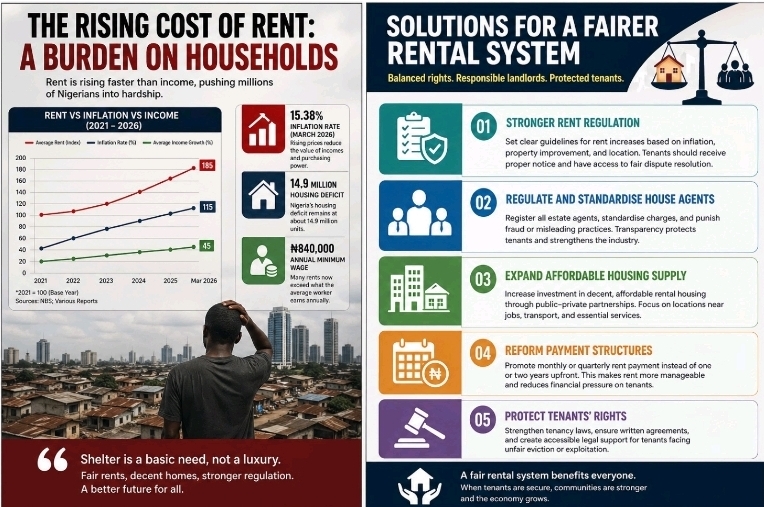
My position is that many landlords and house agents have taken advantage of the current housing shortage and the desperation of tenants. This does not mean that every landlord is exploitative. Some landlords also struggle with repairs, rising prices of cement, labour costs and property levies. However, the problem is that rent increases are often not proportionate to these costs. In many places, a room or flat that was manageable two years ago has doubled or tripled in price, while salaries have not grown at the same rate. A recent report by The Guardian on Lagos showed that some mainland flats that rented for about ₦500,000 two years ago now cost up to ₦2.5 million annually, while tenants on the island reported rent tripling in some areas. The same report noted that Nigeria’s annual minimum wage is ₦840,000, which shows how unrealistic many rents have become for average earners.
The Crisis Is Deepened by Inflation and Weak Household Income
The rent problem cannot be separated from the wider cost-of-living crisis. Nigerians are already dealing with rising food prices, transport costs, school fees, electricity costs and healthcare expenses. When rent is added to these pressures, the household budget becomes almost impossible to manage. Nigeria’s headline inflation rose to 15.38% in March 2026, up from 15.06% in February, according to figures reported by Olalekan Adigun. This means that even before rent is paid, the value of people’s income is already being weakened by general price increases.
The issue is not merely that rent is expensive. The deeper problem is that rent is rising faster than the earning capacity of many tenants. A worker earning ₦150,000 or ₦200,000 monthly may still be expected to pay one or two years’ rent upfront, in addition to agency, agreement and caution fees. This arrangement is unfair because it transfers too much financial pressure onto tenants at once. It also forces many people into borrowing, sharing overcrowded apartments, moving far away from work, or remaining in poor-quality housing because they cannot afford anything better. A society where working people cannot afford basic accommodation is not functioning properly.
House agents also contribute significantly to the burden. In many cases, tenants are not only dealing with landlords but with agents who add inspection fees, agency charges and agreement fees that are sometimes excessive. Some agents collect money from several people for the same apartment, while others advertise properties that are not genuinely available. Even where the transaction is legitimate, the added charges can nearly double the initial cost of securing accommodation. This makes the housing market stressful, uncertain and, for many, humiliating. It is difficult to defend a system where a person must pay so many informal charges before gaining access to shelter.
Housing Shortage Gives Landlords and Agents Too Much Power
One reason landlords and agents can raise rent so aggressively is that decent housing is in short supply. Nigeria’s housing deficit was recently placed at about 14.9 million units by the Federal Government, based on new housing data. This figure is important because it shows that rent increases are not happening in isolation. They are connected to a structural failure to provide enough affordable homes for a growing population.
When demand is high and supply is low, landlords naturally gain more bargaining power. Tenants are often afraid to complain because they know another person is waiting to take the same apartment. This weakens negotiation and encourages arbitrary increases. In such a market, the tenant is not treated as a party with rights but as someone who should be grateful to find accommodation at any price. That attitude is dangerous. It normalises exploitation and makes the housing market hostile to ordinary people.
The effects are visible in daily life. Many workers now live far from their workplaces because rent near commercial centres is unaffordable. This increases transport costs, reduces rest time and affects physical and mental wellbeing. In Lagos, some residents now endure long daily commutes because they cannot afford to live closer to work. The rent crisis therefore creates another crisis: people may still have jobs, but the cost of reaching those jobs consumes their time, energy and income.
This is why the current situation should be described as a housing affordability emergency. It may not be a pandemic in the medical sense, but it has become widespread, harmful and socially destabilising. It affects productivity, family stability, children’s education and community life. If rent continues to rise without control, cities will gradually become places where only the wealthy can live decently, while workers who sustain those cities are pushed to the margins.
Practical Strategies for a Fairer Rental System
The first remedy should be stronger rent regulation. Government should not simply impose unrealistic rent freezes, because that may discourage investment in housing. However, there should be clear rules against arbitrary and excessive increases. Rent increases should be linked to transparent factors such as inflation, property improvement and location, not merely the landlord’s desire to “follow market price”. Tenants should receive proper notice, and there should be accessible complaint mechanisms where unfair increases can be challenged.
Second, house agents must be properly regulated. Every practising estate agent should be registered, traceable and subject to penalties for fraud, excessive charges or misleading advertisements. Agency fees should be standardised, and tenants should not be forced to pay endless informal charges before securing a property. A transparent rental system would protect tenants while also protecting honest agents and landlords from the bad reputation created by exploitative practices.
Third, government must expand affordable housing supply. This is the most important long-term solution. Rent cannot become stable where decent housing remains scarce. Public-private partnerships should focus less on luxury estates and more on practical rental housing for low and middle-income earners. Housing schemes should be located near transport routes, workplaces and basic services. Affordable housing that is built far away from economic opportunities only creates another burden for tenants.
Fourth, payment structures should be reformed. The practice of demanding one or two years’ rent upfront should be reduced. Monthly or quarterly payment systems would make rent more manageable for workers who earn monthly salaries. This approach is more realistic and humane. It allows people to plan their finances without falling into debt simply to secure a roof over their heads.
In conclusion, the current rent situation is not encouraging and cannot be justified as normal market behaviour. It reflects deeper problems: inflation, weak income, housing shortage, poor regulation and exploitative agency practices. Landlords deserve fair returns on their property, but tenants also deserve dignity, stability and protection. A fair society must not allow shelter to become a privilege for only those who can survive sudden and excessive rent increases. The solution is not to attack landlords, but to build a more balanced rental system where profit does not destroy humanity.
‘Pelumi, a Broadcast Journalist, Student, and Researcher,
Wrote via:
olusegunolukoga@gmail.com


1 Comment
This is indeed timely
I think most of the problems arise from the agents.