

Olusegun Pelumi Olukoga
The rise in the cost of living in Nigeria has become one of the most painful realities facing civil servants, low-income workers and ordinary families. The issue is not simply that prices have gone up. The deeper problem is that the prices of food, transport, cooking gas, rent, school costs and daily essentials have moved faster than people’s salaries. A worker may still receive the same monthly pay, or only a modest adjustment, but the market behaves as if that worker’s income has doubled. This is where the real hardship begins. In my view, the present situation is not just an economic inconvenience. It is a daily struggle that quietly reduces dignity, weakens family stability and turns basic survival into a constant calculation.
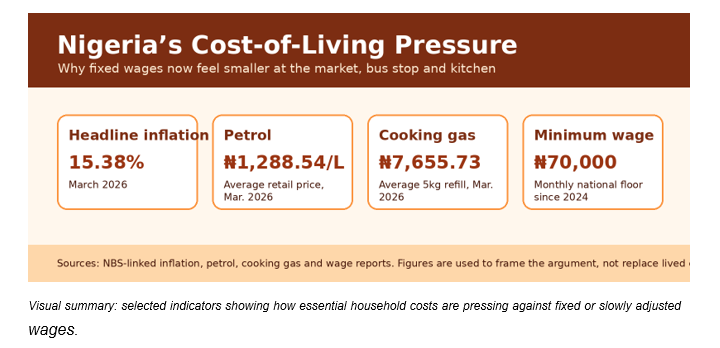
The point must be made carefully. Nigeria did introduce a new national minimum wage in 2024. The National Minimum Wage (Amendment) Act, 2024 increased the wage floor and reduced the review period from five years to three years. The National Salaries, Incomes and Wages Commission also listed circulars for implementing the new minimum wage across federal salary structures. However, this does not remove the lived reality that many salaries, especially in the public sector and among low-paid workers, remain too weak when compared with actual household expenses. A salary increase that is swallowed by food, fuel and transport within days cannot be described as real relief.
The Salary-Price Gap Has Become the Real Crisis
The most serious part of the current hardship is the gap between income and prices. According to NBS-linked reporting, Nigeria’s headline inflation rose to 15.38% in March 2026, up from 15.06% in February, while month-on-month inflation stood at 4.18%. These numbers may look technical, but their meaning is simple: the same salary buys less food, less fuel, less electricity and less comfort. For a civil servant paid monthly, inflation is not an abstract percentage. It is the moment a basket that once carried rice, beans, garri, oil and meat begins to return home half-empty.
Food is the clearest evidence of this pressure because it cannot be postponed. Families may delay buying clothes, furniture or electronics, but they cannot delay eating. The National Bureau of Statistics’ Selected Food Price Watch remains one of the most useful official sources for tracking staple prices across Nigeria. Recent reporting from that series showed that, even where some items fell compared with the previous year, prices were still heavy for ordinary households: brown beans stood at ₦1,325.85 per kilogram and white garri at ₦801.54 per kilogram in March 2026. In practical terms, a market visit has become a negotiation between hunger, health and the available cash at hand.
The hardship is not limited to food. Transport and energy costs multiply the pressure. NBS-linked reporting showed that the average retail price of petrol rose from ₦1,051.47 in February 2026 to ₦1,288.54 per litre in March 2026. Cooking gas also became more expensive, with the average 5kg refill rising from ₦6,799.18 in February to ₦7,655.73 in March 2026. These increases affect almost everything. Once fuel becomes expensive, transport fares rise. Once transport rises, food delivery and market prices rise. Once cooking gas rises, even the food bought from the market becomes more costly to prepare. The ordinary worker is therefore not facing one problem, but a chain of connected problems.
Survival Through Sacrifice, Not Comfort
Many Nigerians are coping, but it would be dishonest to describe this coping as normal living. What is happening is survival through sacrifice. People reduce meal portions, replace protein with cheaper alternatives, buy food in smaller quantities, walk part of the journey to work, share transport, delay medical treatment, reduce social visits and depend more heavily on informal borrowing. Some civil servants now plan their entire month around payday, but within a week or two the salary is already weakened by debt repayment, food purchases, school fees, transport and electricity bills.
This kind of coping carries hidden damage. A parent who removes meat, fish or eggs from family meals is not only saving money; they may also be reducing nutrition. A worker who skips breakfast to save transport money may become less productive. A family that delays hospital visits may face worse health outcomes later. A young graduate who spends most of a salary on transport and feeding has little chance of saving, investing or building a stable future. Therefore, the cost-of-living crisis is not only about today’s hunger. It is also about tomorrow’s poverty.
There is also a moral question. Civil servants and other workers keep public offices, schools, hospitals, security units and local administration functioning. If these workers cannot afford basic necessities, the system is asking them to serve the public while privately struggling to feed their own families. That contradiction cannot be ignored. A state cannot build an efficient public service on exhausted workers whose salaries no longer reflect the cost of decent living.
What Must Change Without Pretence
The first remedy should be a more realistic wage adjustment system. Nigeria should not wait for hardship to become unbearable before reviewing salaries. Since the law now provides for a three-year review cycle, government should go further by linking public-sector wage reviews to verified inflation, food prices and transport costs. This does not mean reckless wage increases that worsen inflation. It means a structured and evidence-based adjustment that protects workers from complete erosion of purchasing power.
Second, government must target food prices directly. The most practical approach is to reduce the cost of production and movement, not merely announce temporary food releases. Farmers need access to affordable inputs, safer farming routes, storage facilities, credit and reliable transportation. When insecurity, fuel costs, poor roads and storage losses remain unresolved, food prices will continue to punish consumers. Food inflation is not solved at the market stall; it is solved from the farm, through transport, storage and distribution.
Third, transport and energy relief should be treated as household welfare policies. Subsidised mass transit for workers, support for compressed natural gas buses, reduced public transport fares on major routes and more reliable electricity would reduce the pressure on household spending. Cooking gas costs should also be addressed through stronger domestic supply, better distribution and lower bottlenecks in the LPG value chain. A worker who spends less on transport and cooking fuel has more money left for food, education and healthcare.
Fourth, salary support should be accompanied by accountability. Palliatives should not become political announcements without measurable delivery. Relief programmes must be transparent, targeted and traceable. Low-income civil servants, pensioners, students and vulnerable households should be prioritised through reliable databases. Where cash support is used, it must be predictable enough to help families plan, not occasional enough to become symbolic.
Finally, Nigerians also need practical household-level resilience, although this should not be used as an excuse for government failure. Families may need to budget more strictly, buy collectively, reduce waste, prioritise essential spending and develop small supplementary income where possible. However, personal discipline cannot solve a structural crisis alone. No amount of budgeting can make a weak salary sufficient when food, transport and energy rise faster than income.
In conclusion, the rise in the cost of living in Nigeria has exposed a painful truth: income has become too slow for the speed of prices. Civil servants and ordinary families are coping, but many are coping by sacrificing comfort, nutrition, health and future security. The solution must therefore be serious, practical and honest. Nigeria needs wage protection, food price intervention, transport and energy relief, and transparent support for vulnerable households. A country should not measure economic progress only by policies announced, but by whether working people can afford to live with dignity after receiving their salaries.
‘Pelumi, a Broadcast Journalist, Student, and Researcher,
Wrote via:
olusegunolukoga@gmail.com


1 Comment
Very timely
I hope this can go viral