

Olusegun Pelumi Olukoga
Nigeria has become one of the world’s trafficking hotspots, serving as a source, transit and destination for human exploitation. The United Nations reports that roughly two‐thirds of trafficking cases in Nigeria happen internally, with the rest involving Nigerians abroad. About 1.6 million Nigerians live in modern slavery today. In recent years, the government has identified thousands of victims, and NAPTIP (the National Agency for the Prohibition of Trafficking in Persons) proudly notes it has assisted over 19,000 victims. Many of those victims are women and girls from Edo, Delta and the North, lured by false job offers. Young Nigerian women often believe they are going abroad for “high-paying overseas employment”, only to be tricked and trapped in exploitative situations. Traffickers promise riches and freedom, then force victims into prostitution, labor or even organ harvesting. Thus; Human trafficking is highly dehumanising; it reduces victims to mere commodities.
Despite laws (Nigeria ratified the UN “Palermo” Protocol in 2000 and passed the Trafficking in Persons Act in 2003), enforcement appears to be very weak. Corruption at road checkpoints and some police stations is a serious problem; bribe-taking and complicity allow smugglers to operate freely. Traffickers exploit lapses in screening: girls traveling with older men or without papers are often not identified by guards. Nigeria’s porous borders with Niger, Chad and Libya make it so easy for rings to ferry victims across the Sahara. Many Nigerians attempting the Atlantic crossing to Europe end up shipwrecked or enslaved in Libya. These journeys are deadly: survivors tell horror stories of dehydration and violence. The high death toll is one reason trafficking must be tackled as a national emergency.
Training Front-Line Officials
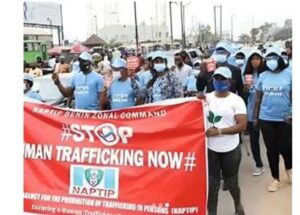
A first priority is ensuring that police, immigration officers, border guards and social workers can recognise trafficking victims. NAPTIP has developed standardised protocols (consistent with UN guidelines) for identifying and referring victims, and officials use a “rapid assessment” form in the field. These tools need wide rollout. For example, mandatory workshops at all major airports and land crossings could train officers to spot red flags such as unaccompanied young girls with no documents, or children working far from home. NAPTIP’s 2023 report indicates that the government continued training key stakeholders, including law enforcement and social service providers, on the use of standardized forms to identify and refer victims of human trafficking. In practice, however, many front-line officials still lack awareness of trafficking indicators. Expanding these trainings with practical exercises and local case studies9 would empower officers to act.
NAPTIP already offers a 24/7 toll-free hotline and even a mobile app for tip-offs, but these must be publicised. Community radio, posters, school and church campaigns can advertise the numbers. Social workers and healthcare providers should also be trained: in many cases the first sign of trouble is a clinic visit for abuse or a child stopped asking questions. Finally, every police station should receive updated referral guidelines (the National Referral Mechanism) so that once a victim is identified, there is a clear, trauma-informed path to shelter and care.
Regional and International Cooperation
Trafficking networks span Africa and beyond. No country can fight them alone. Nigeria must deepen collaboration with its neighbours and partners. Already, Abuja cooperates with ECOWAS (West African) initiatives: for example, it participates in joint border patrols with Niger and Benin to intercept child trafficking rings along river routes. Nigerian authorities also exchange intelligence with INTERPOL and African anti-trafficking networks. A notable example is the Nigerian–UK Joint Border Task Force, which carries out operations on both continents to dismantle criminal gangs. These efforts should expand: in practical terms this means sharing arrest data, conducting cross-border raids, and even extraditing known traffickers. ECOWAS’s treaties on mutual legal assistance and extradition can be used to make the region “a dead end” for traffickers.
At the diplomatic level, Nigeria should lead the region in signing formal agreements on trafficking (as it did for drug smuggling). At sea, Nigerian authorities and regional navies could patrol known smuggling routes in the Gulf of Guinea. And in Europe, Nigerian embassies should support investigations – the government already repatriates victims with embassy help – but could go further by prosecuting Nigerian-based facilitators abroad. Regional collaboration is essential for success: only by working with neighbours and international agencies can Nigeria track fugitives and shut down cross-border rings.
Supporting Survivors and Reintegration
Rescuing victims is only the first step. Survivors often return home with deep scars and no safety net. Nigeria needs to vastly expand its support services. NAPTIP currently runs about 14 shelters (one per zone) across the country, but their capacity is tiny compared to the need. In one recent year NAPTIP’s shelters served around 2,058 victims. Those shelters offer medical check-ups, six weeks of meals and bed, plus counselling, basic education and vocational training (tailoring, farming or literacy classes). However, staff and space are limited. Many survivors are sent home “traumatised” and impoverished, with “inadequate medical, counseling, and financial support to reintegrate into society”. Some centers even detain women for months, violating their rights.
To fix this, each geo-political zone should have a fully staffed referral center. These centers would combine NAPTIP’s existing shelters with public hospitals, psychologists, legal aid lawyers and job trainers. Victims must get immediate healthcare (sometimes survivors arrive injured or pregnant), mental health counseling, and help navigating any legal case. Crucially, programs should fund longer-term support: skills training to find a livelihood, scholarships to finish school, or micro-grants to start a business. Community outreach is also key. Survivors face stigma or even blame when they return. Engaging traditional rulers and religious leaders to publicly welcome survivors can ease that stigma. Faith and women’s groups can mentor returnees.
Nigerian officials must listen to victims themselves. Survivors need the government to help them heal from the trauma and earn a decent living in Nigeria. In other words, protecting victims is not only a moral duty but a practical one: without true reintegration support, many risk being trafficked again.
Conclusion
Human trafficking destroys lives and tramples human rights. Year after year, thousands of young Nigerians are sold into slavery across the Sahara Desert or the Atlantic Ocean. But Nigeria has begun to build the tools to fight back: better laws, identification protocols, and awareness campaigns in schools. The remaining challenge is scale and resolve. Policymakers must urgently fund and implement the measures above. Training workshops, intelligence-sharing with ECOWAS neighbors, and genuine survivor care are not optional extras – they are essential. Every trafficker prosecuted and every survivor supported sends a message: trafficking is intolerable in Nigeria. With coordinated action and public vigilance, Nigerians can break this cycle of violence and offer hope to the many who were lured by false promises of a better life.
‘Pelumi, a Broadcast Journalist, Student, and Researcher, wrote via: olusegunolukoga@gmail.com

